HRMS Buyer’s Guide 2026
A practical guide to choosing HRMS software for payroll, attendance, compliance, workforce automation, and operational control in Indian businesses.
Managing employees manually is becoming increasingly difficult for Indian businesses. As organizations grow, HR teams often struggle with payroll processing, attendance tracking, compliance management, shift scheduling, employee records, and workforce visibility across multiple locations.
This is why businesses across manufacturing, logistics, retail, hospitality, IT, and service industries are rapidly adopting Human Resource Management Software (HRMS).
Modern HRMS software helps organizations automate payroll, simplify attendance management, reduce compliance risks, and improve overall workforce productivity.
In this guide, we will explore:
- What human resource management software is
- Why Indian companies are moving away from Excel-based HR processes
- Key features businesses should look for
- Best HRMS software options in India
- Pricing considerations
- How to choose the right HR software for your business
- Why workforce-heavy companies require operational HRMS solutions
What Is Human Resource Management Software?
Human Resource Management Software (HRMS) is a digital platform that helps businesses automate and manage HR operations such as:
- Employee database management
- Payroll processing
- Attendance tracking
- Leave management
- Compliance management
- Recruitment workflows
- Performance management
- Employee self-service
- Shift and overtime management
Instead of managing HR operations through Excel sheets, emails, and manual paperwork, HRMS software centralizes all employee-related information into one system.
For Indian businesses, HRMS software has become critical due to increasing workforce complexity, labour law compliance requirements, multi-location operations, and payroll accuracy demands.
Why Indian Businesses Are Moving From Excel to HRMS Software
Many SMEs and mid-sized companies still rely on Excel spreadsheets for HR operations. While this may work temporarily for small teams, it creates major operational problems as the workforce grows.
Common Problems With Manual HR Processes
Payroll Errors
Manual salary calculations often lead to:
- incorrect deductions
- overtime calculation mistakes
- wrong leave adjustments
- PF and ESIC errors
- delayed salary processing
Even small payroll mistakes can impact employee trust and create compliance issues.
Attendance Mismatch
Businesses managing:
- factory workers
- contract labour
- multiple shifts
- field employees
- remote teams
often struggle with attendance reconciliation.
Manual attendance systems create:
- buddy punching
- fake overtime claims
- missing attendance records
- shift confusion
Compliance Risks
Indian labour compliance requirements are becoming stricter.
Organizations must regularly manage:
- PF
- ESIC
- PT
- TDS
- labour laws
- statutory filings
Manual compliance handling increases the risk of:
- penalties
- audit failures
- delayed filings
Lack of Workforce Visibility
Without centralized HR software, management teams often lack visibility into:
- employee productivity
- attendance patterns
- overtime costs
- leave trends
- contractor workforce data
This affects operational planning and cost control.
Key Features to Look for in Human Resource Management Software India
Choosing the right HRMS software is not only about features. Businesses should evaluate whether the software can handle operational workforce requirements efficiently.
1. Payroll Management
Payroll is one of the most critical HR functions.
Good payroll software should support:
- automated salary calculation
- overtime calculation
- shift-based payroll
- bonus management
- arrears
- full & final settlement
- statutory deductions
- payroll reports
For Indian companies, payroll compliance accuracy is extremely important.
2. Attendance Management
Modern attendance systems should support:
- biometric integration
- mobile attendance
- geo attendance
- shift management
- overtime tracking
- attendance regularization
Businesses with workforce-heavy operations require real-time attendance visibility.
3. Leave Management
An efficient leave management system helps automate:
- leave applications
- approvals
- leave balance calculation
- holiday calendars
- leave encashment
This reduces manual coordination between employees and HR teams.
4. Employee Self-Service (ESS)
Employee Self-Service portals allow employees to:
- download payslips
- apply for leave
- mark attendance
- update personal details
- access HR documents
This significantly reduces HR administrative workload.
5. Compliance Management
Compliance management features help businesses manage:
- PF
- ESIC
- PT
- TDS
- labour compliance
- statutory reporting
Automated compliance reduces legal and financial risks.
6. Recruitment & Onboarding
HRMS software should simplify:
- candidate tracking
- interview scheduling
- offer management
- onboarding documentation
- employee induction
This improves hiring efficiency.
7. Appraisal & Performance Management
Performance modules help organizations:
- conduct reviews
- define KPIs
- manage appraisals
- track employee goals
This improves workforce performance management.
8. Mobile Accessibility
Modern HRMS software should provide mobile access for:
- attendance
- approvals
- leave requests
- payslip access
- employee communication
Mobile HRMS platforms are especially important for field teams and remote workforce management.
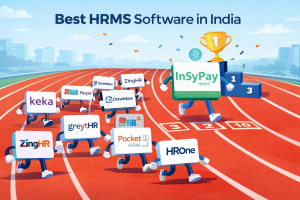
Best Human Resource Management Software in India
Below is a comparison of popular HRMS software solutions available in India.
| HR Software | Founded | Pricing (Starting) | Avg. Rating | Best For |
|---|---|---|---|---|
| InSyPay HRMS | 2014 | ₹70/user/month | 4.4 | SMEs to Enterprises |
| Zoho People | 2008 | ₹48/user/month (billed annually) | 4.3 | SMEs to Enterprises |
| Darwinbox | 2015 | Custom Pricing | 3.9 | Mid to Large Enterprises |
| Keka HR | 2015 | ₹6,999/month (up to 100 employees) | 4.3 | SMEs to Enterprises |
| ZingHR | 2014 | Custom Pricing | 4.7 | Large Enterprises |
| greytHR | 1994 | ₹50/month (up to 50 employees) | 4.3 | SMEs to Enterprises |
| Pocket HRMS | 2013 | ₹60/user/month | 4.0 | SMEs & Mid-sized |
| PeopleHum | 2015 | $2/user/month | 4.3 | SMEs to Enterprises |
| HROne | 2016 | ₹4950/month | 4.2 | SMEs to Mid-market |
| Quikchex | 2019 | ₹4500/month | 4.1 | SMEs & Startups |
Human Resource Management Software for Manufacturing Companies
Manufacturing companies face unique workforce management challenges.
Unlike standard office-based operations, manufacturing businesses must manage:
- multiple shifts
- overtime
- contractor labour
- biometric attendance
- compliance-heavy payroll
- workforce tracking
- production-linked manpower planning
This makes operational HRMS capabilities extremely important.
For a deeper industry-specific guide, read Best HRMS Software for Manufacturing Companies in India.
Key Manufacturing HR Challenges
Shift Management Complexity
Factories often run:
- day shifts
- night shifts
- rotational shifts
Manual shift tracking creates payroll discrepancies and attendance conflicts.
Contractor Workforce Management
Manufacturing businesses frequently employ:
- contract labour
- temporary workers
- seasonal workforce
Managing contractor attendance and wage calculations manually becomes difficult at scale.
Payroll Accuracy
Factory payroll often includes:
- overtime
- attendance incentives
- shift allowances
- production-linked incentives
HRMS software helps automate these calculations.
Compliance Management
Manufacturing companies must maintain accurate statutory compliance records.
Failure to manage:
- PF
- ESIC
- labour compliance
- contractor records
can create significant legal exposure.
Common HR Challenges HRMS Software Solves
Delayed Payroll Processing
Automated payroll workflows reduce salary processing time and improve payroll accuracy.
Attendance Fraud
Biometric and geo attendance systems reduce:
- buddy punching
- fake attendance
- duplicate entries
Manual Approval Delays
HRMS automation speeds up:
- leave approvals
- reimbursement approvals
- attendance regularization
Employee Data Silos
Centralized employee records improve workforce visibility and reduce duplicate data management.
Compliance Tracking Issues
Automated compliance workflows reduce manual filing dependency.
How Much Does HRMS Software Cost in India?
HRMS software pricing in India depends on:
- company size
- number of employees
- modules required
- customization needs
- deployment model
Typical HRMS Pricing Models
Per Employee Pricing
Many HRMS platforms charge:
- ₹40–₹150 per employee per month
Module-Based Pricing
Pricing may vary based on:
- payroll
- attendance
- recruitment
- compliance
- performance management
Enterprise Pricing
Large organizations often require:
- custom workflows
- API integrations
- advanced reporting
- dedicated support
Enterprise pricing is usually customized.
How to Choose the Right Human Resource Management Software
Choosing the right HRMS software requires more than comparing features.
Businesses should evaluate:
Workforce Complexity
Consider:
- shifts
- contractor workforce
- remote employees
- multiple branches
- overtime dependency
Payroll & Compliance Accuracy
Payroll accuracy should be a major evaluation factor.
Incorrect payroll processing can directly impact:
- employee satisfaction
- compliance
- operational trust
Scalability
Choose software that can scale with:
- workforce growth
- additional branches
- operational expansion
Ease of Implementation
A complicated implementation can delay HR transformation projects.
Businesses should evaluate:
- onboarding support
- training
- implementation timelines
- customer assistance
Customization Capability
Every industry has different HR workflows.
Manufacturing and workforce-heavy businesses often require:
- custom attendance rules
- overtime policies
- contractor workflows
- shift logic
Customization flexibility becomes critical.
Why InSyPay HRMS Is Suitable for Indian Businesses
InSyPay HRMS is designed to support Indian businesses that require operational workforce control, payroll accuracy, and compliance automation in a single platform.
Previously known as InSysPay, the platform supports businesses ranging from SMEs to enterprises.
Key Strengths of InSyPay HRMS
Workforce Management
Supports:
- attendance tracking
- shift management
- payroll processing
- employee lifecycle management
Payroll & Compliance Automation
The platform helps automate:
- salary processing
- statutory calculations
- payroll reporting
- TDS workflows
Customization Flexibility
Businesses can customize workflows based on:
- industry requirements
- workforce structure
- operational processes
Integrated HR Modules
InSyPay offers:
- payroll management
- attendance management
- recruitment management
- appraisal management
- training management
- travel expense management
- employee self-service
- task management
Workforce-Heavy Industry Support
The platform is suitable for:
- manufacturing
- logistics
- contractor workforce
- multi-location businesses
What Users Say About InSyPay HRMS
Several users have highlighted:
- payroll automation
- customization flexibility
- workforce management
- attendance tracking
- centralized HR workflows
Users also noted improvements in:
- manual HR workload reduction
- attendance visibility
- payroll efficiency
Some reviews additionally highlighted areas such as UI modernization and multilingual support as future improvement opportunities.
Frequently Asked Questions
Which is the best human resource management software in India?
The best HRMS software depends on:
- company size
- workforce complexity
- payroll requirements
- compliance needs
- industry workflows
Popular options include InSyPay, Zoho People, Keka, Darwinbox, and greytHR.
What is the average cost of HRMS software in India?
Most HRMS software platforms charge between:
- ₹40 to ₹150 per employee per month
Enterprise pricing may vary based on customization and integrations.
Is HRMS software suitable for manufacturing companies?
Yes. Manufacturing companies benefit significantly from HRMS software due to:
- shift management
- overtime automation
- contractor workforce tracking
- payroll accuracy
- compliance management
What features should HRMS software include?
Businesses should look for:
- payroll management
- attendance tracking
- leave management
- compliance automation
- ESS portal
- mobile access
- recruitment workflows
- reporting dashboards
What is the difference between payroll software and HRMS software?
Payroll software mainly focuses on salary processing.
HRMS software provides broader workforce management capabilities including:
- attendance
- leave
- recruitment
- performance management
- employee records
- compliance management
Final Thoughts
Human Resource Management Software is no longer optional for growing businesses in India.
As workforce complexity increases, organizations require centralized HR systems that can automate payroll, attendance, compliance, and workforce operations efficiently.
Businesses that continue relying on manual HR processes often face:
- payroll inaccuracies
- operational inefficiencies
- compliance risks
- limited workforce visibility
Choosing the right HRMS platform can help organizations improve operational control, reduce manual dependency, and build scalable HR processes for long-term growth.
For businesses managing workforce-heavy operations, payroll-intensive environments, or multi-location teams, selecting an HRMS solution with strong operational capabilities becomes even more critical.
Book Demo